5 Essential Stretches Every Runner Should Do

Running asks a lot from a few hard-working areas: calves, quads, hamstrings, hips, and glutes. When those tissues get tight or tired, your stride can start to feel shorter, heavier, and less natural.
Stretching will not fix every ache, and it is not a magic shield against injury. Still, a simple stretching routine can help many runners move more comfortably, recover with better awareness, and spot tightness before it becomes a bigger problem; especially when paired with regular massage therapy care in North Vancouver.
The key is choosing the right stretches and doing them at the right time. These five runner-friendly stretches cover the muscles that do the most work on the road, trail, treadmill, or track.
This article is for general fitness information only. If you have sharp pain, an injury, numbness, swelling, or pain that changes your gait, check with a qualified health professional.

Stretch smarter before and after running
The best stretching routine is not complicated. It fits the run you are about to do, or the one you just finished.
Before a run, your body usually responds best to dynamic movement. That means moving through a range of motion without holding one position for a long time. Think leg swings, walking lunges, ankle circles, or a slow jog. These movements help raise your body temperature and prepare your joints for the repeated impact of running.
After a run, static stretching makes more sense. Your muscles are already warm, and longer holds can help you settle your breathing, reduce tension, and notice which areas feel restricted.
A good rule:
Before running, move gently and keep things active.
After running, hold stretches for 20 to 45 seconds.
Skip aggressive bouncing.
Stretch to mild tension, not pain.
Breathe slowly and keep your posture relaxed.
If time is short, even five minutes after an easy run can help. Pick the tightest two or three areas and go through them with care. Consistency matters more than forcing a perfect routine once in a while.

These five stretches cover the main running muscles
Each stretch below targets a common tight spot for runners. You do not need special equipment, though a mat, wall, bench, or curb can make a few of them easier.
Move slowly into each position. If one side feels tighter, spend a little more time there, but avoid forcing symmetry. Bodies are rarely perfectly even.
1. Standing calf stretch
Your calves work with every foot strike. They help absorb impact, push you forward, and support your ankles. Tight calves can make your stride feel stiff, especially during hills, speed work, or runs on colder days.
The standing calf stretch is simple, effective, and easy to do almost anywhere.
How to do it:
Stand facing a wall, fence, or sturdy post.
Place both hands on the surface at shoulder height.
Step one foot back.
Keep the back heel on the ground and the back knee straight.
Bend the front knee until you feel a stretch in the back calf.
Hold for 20 to 45 seconds, then switch sides.
For a deeper variation, bend the back knee slightly while keeping the heel down. This shifts the stretch lower toward the Achilles area and deeper calf muscles.
Keep the back foot pointing straight ahead. If it turns outward, the stretch changes and may miss the area you want.
Best time to use it:
After runs
After hill sessions
After long walks in stiff shoes
Any time your calves feel loaded or tight
Runner’s tip:
Do not jam your heel into the ground. Think of lengthening through the back of the lower leg while keeping your hips square to the wall.
2. Kneeling hip flexor stretch
Many runners feel tight through the front of the hips. The hip flexors help lift the thigh forward during each stride. They can also feel shortened after long periods of sitting, which may affect how freely your leg swings behind you.
This stretch targets the front of the hip and upper thigh. Done well, it can make your stride feel more open without needing to arch your lower back.
How to do it:
Kneel on one knee with the other foot planted in front.
Keep both knees bent at about 90 degrees.
Gently tuck your pelvis under, as if you are shortening the front of your waist.
Shift your hips forward a few centimetres.
Stop when you feel a stretch at the front of the back hip.
Hold for 20 to 45 seconds, then switch sides.
If kneeling bothers your knee, place a folded towel, cushion, or mat underneath it.
The most common mistake is leaning back and arching the lower spine. That can make the stretch feel bigger, but it often moves the work away from the hip flexors. Keep your ribs stacked over your pelvis.
To increase the stretch, lift the arm on the kneeling side and reach slightly upward. Keep the movement controlled and avoid twisting.
Best time to use it:
After runs
After sitting for long periods
After speed sessions or hill work
Before strength training, using a shorter dynamic version
Runner’s tip:
Think tall posture, gentle tuck, small shift. You do not need a big lunge to get a useful stretch.
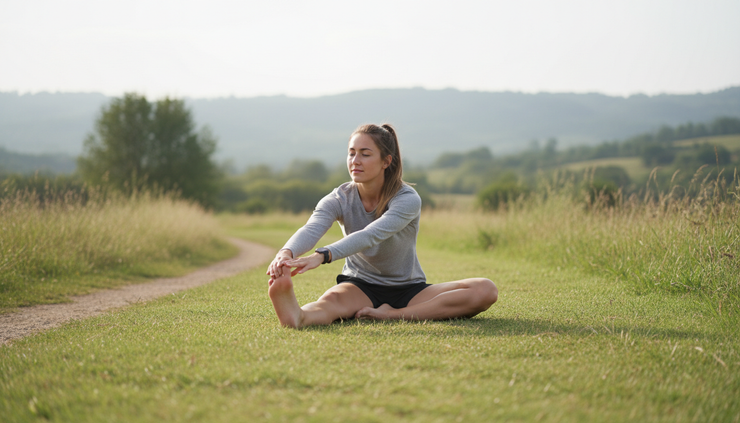
3. Seated hamstring stretch
The hamstrings run along the back of the thigh. They help bend the knee and extend the hip, both of which matter during running. When they feel tight, many runners bend forward and reach hard for the toes. That can pull more on the lower back than the hamstrings.
A seated version gives you better control.
How to do it:
Sit on the floor with one leg extended.
Bend the other knee and rest that foot near the inner thigh of the straight leg.
Sit tall and point the toes of the extended leg upward.
Hinge forward from the hips.
Stop when you feel a stretch along the back of the thigh.
Hold for 20 to 45 seconds, then switch sides.
Keep your spine long. You do not need to touch your toes. If sitting upright is difficult, sit on a folded towel or yoga block. Raising your hips can make the position more comfortable and help your pelvis tilt forward.
If you feel the stretch mostly behind the knee or in the calf, soften the knee slightly. A small bend can help the hamstring relax.
Best time to use it:
After easy runs
After long runs
After strength workouts that include deadlifts or lunges
On recovery days
Runner’s tip:
Aim your chest toward your shin, not your forehead toward your knee. That keeps the stretch cleaner and reduces rounding through the back.
4. Standing quad stretch
The quadriceps are the large muscles at the front of the thigh. They help control knee bend, absorb impact, and support downhill running. If you have ever felt your thighs burn on a long descent, your quads were doing plenty of braking work.
The standing quad stretch is a classic, but small changes make it much more useful.
How to do it:
Stand tall near a wall or railing for balance.
Bend one knee and bring your heel toward your glutes.
Hold your ankle or the top of your foot.
Keep your knees close together.
Gently tuck your pelvis under.
Hold for 20 to 45 seconds, then switch sides.
The goal is to feel the stretch through the front of the thigh, not your lower back. If your knee points far out to the side or your back arches, reset your position.
If grabbing your foot is uncomfortable, loop a towel or strap around your ankle. You can also do this stretch lying on your side, which removes the balance challenge.
Best time to use it:
After hilly runs
After intervals
After treadmill sessions
After leg strength workouts
Runner’s tip:
Keep the standing knee soft rather than locked. A tiny bend helps you stay balanced and relaxed.
5. Figure-four glute stretch
The glutes help stabilize the pelvis and drive the leg behind you. They also support the hips when you land on one foot, which happens with every running step. Tightness through the glutes or deep hip rotators can make the hips feel restricted and may change how your stride feels.
The figure-four stretch targets the glutes and outer hip. You can do it lying down, seated, or standing. The lying version is often the easiest to control.
How to do it:
Lie on your back with both knees bent.
Cross one ankle over the opposite thigh, making a figure-four shape.
Keep the crossed foot flexed.
Pull the uncrossed thigh gently toward your chest.
Stop when you feel a stretch in the glute of the crossed leg.
Hold for 20 to 45 seconds, then switch sides.
Keep your head and shoulders relaxed. If reaching behind your thigh is difficult, use a towel behind the leg to bring it closer.
Do not push hard on the crossed knee. Let the position and your breathing create the stretch.
Best time to use it:
After runs
After long drives or sitting
On recovery days
After strength work that includes squats, step-ups, or lunges
Runner’s tip:
Flex the foot of the crossed leg. This can help protect the knee and keep the stretch focused at the hip.
Build a simple routine that you will actually repeat
A stretching routine works best when it is short enough to repeat. You do not need a long mobility session after every run. Start with a simple 5 to 8 minute flow.
Try this after an easy run:
Stretch | Hold time | Notes |
Standing calf stretch | 30 seconds per side | Keep the back heel down |
Kneeling hip flexor stretch | 30 seconds per side | Tuck the pelvis gently |
Seated hamstring stretch | 30 seconds per side | Hinge from the hips |
Standing quad stretch | 30 seconds per side | Keep knees close |
Figure-four glute stretch | 30 seconds per side | Keep shoulders relaxed |
That routine takes about five minutes, plus a little time to change positions. If you ran hard or long, repeat the tightest two stretches for a second round.
For pre-run mobility, turn some of these into gentle movement:
Use walking lunges instead of a long hip flexor hold.
Do ankle rocks instead of a static calf stretch.
Try controlled leg swings instead of a held hamstring stretch.
Add bodyweight squats to wake up the hips and quads.
A simple pattern can help:
Walk for a few minutes.
Do dynamic mobility before the run.
Run.
Cool down with easy walking.
Use static stretches after your breathing settles.
This keeps stretching in the right role. It supports your running rather than taking over your training.

What to watch for when stretching
Stretching should feel like mild to moderate tension. It should not feel sharp, electric, pinchy, or unstable. If a stretch causes pain, back out of it. Try a smaller range, change the angle, or skip that stretch for the day.
A few habits make these stretches safer and more useful:
Breathe through each hold. Holding your breath can make your body brace.
Move in and out slowly. Quick, jerky movement can increase tension.
Match the stretch to the day. A hard workout may call for gentler holds.
Track patterns. If the same spot always feels tight, strength, recovery, footwear, or training load may also matter.
Respect fatigue. Deep stretching right after a very hard effort may not feel great for everyone.
Stretching is only one part of staying comfortable as a runner. Sleep, rest days, gradual mileage changes, strength work, shoes that suit your gait and regular massage care all play a role.
Still, these five stretches give you a useful starting point. They cover the areas runners tend to notice most: calves, hip flexors, hamstrings, quads, and glutes.
Use them after your next run. Keep the holds gentle, pay attention to how each side feels, and repeat the routine often enough that it becomes automatic. A few calm minutes can make the next kilometres feel a lot better.
For a more tailored plan to your specific needs, book in with one of our massage therapists in North Vancouver and they will help get you feeling your best!


Comments